Lanai City Weeknight Things to Do and the Local Evening Rhythm
August 6, 2026
August 6, 2026
A well-worn Tripadvisor line about our town says there isn't much to do here at night. That's the visitor read, written after one dinner and a 9 p.m. walk down an empty Lānaʻi Avenue. It misses the shape of the actual week.
If you live here, you already know the shape. You just may not have seen it mapped. Two venues carry most of the weeknight load in Lānaʻi City, and their schedules interlock in a way that makes some evenings dense and others quiet by design. This is what that clock looks like in August 2026, and why the quiet nights are quieter than most residents realize.
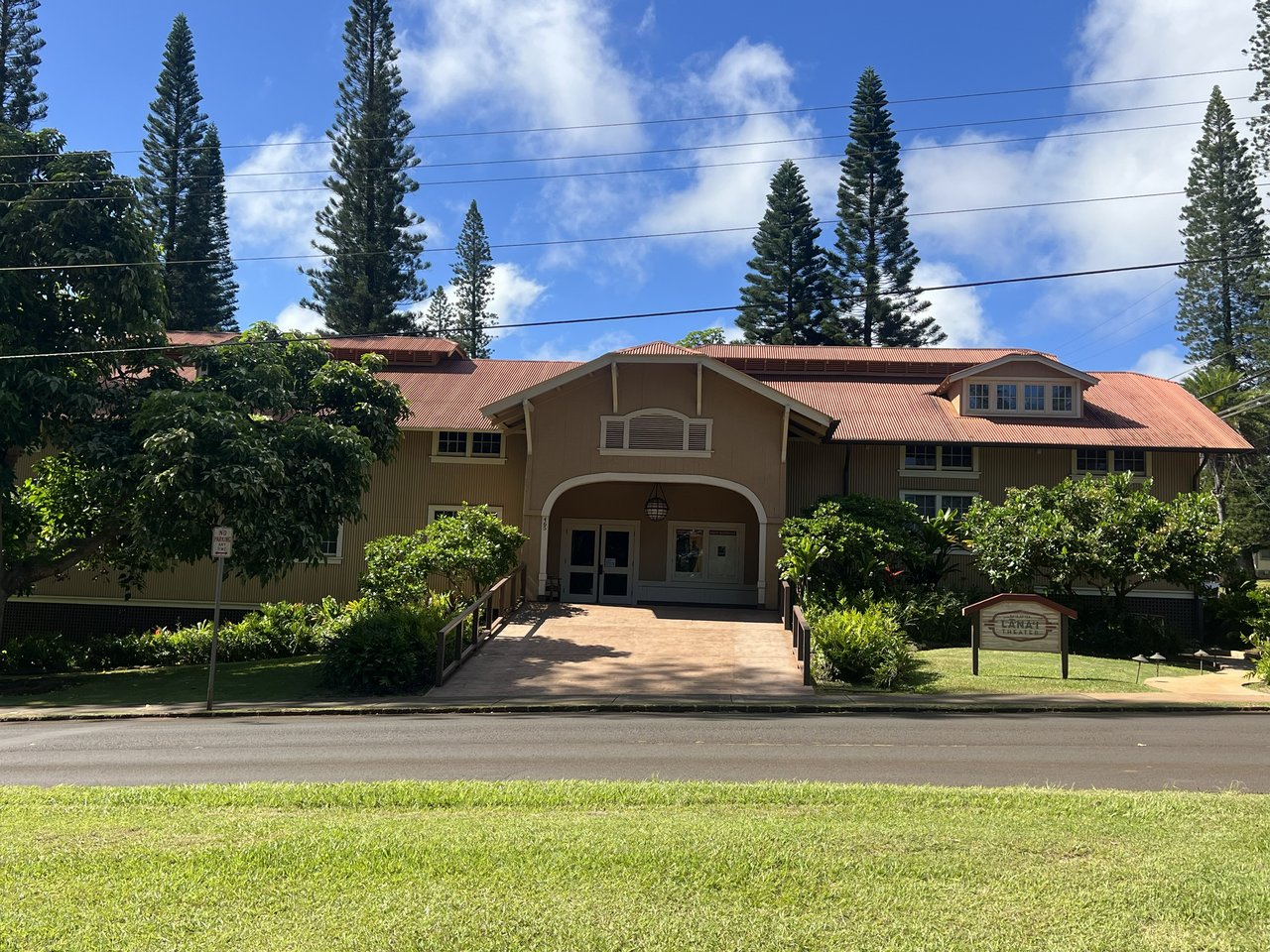
Almost every non-resort evening decision in town runs through two doors: the theater at 465 7th Street and the grill at 828 Lānaʻi Avenue. Everything else is a supporting act.
Hale Keaka posts current 2026 hours of Monday through Wednesday closed, Thursday 5 p.m. to 10 p.m., Friday 3:30 p.m. to 11 p.m., Saturday 3:30 p.m. to 11 p.m., and Sunday noon to 8 p.m. Lanai City Grill runs Tuesday through Saturday, 4 p.m. to 9 p.m., and is closed Monday. Put those next to each other and the week takes on a legible pattern:
Day | Hale Keaka | Lanai City Grill |
|---|---|---|
Mon | Closed | Closed |
Tue | Closed | 4–9 p.m. |
Wed | Closed | 4–9 p.m. |
Thu | 5–10 p.m. | 4–9 p.m. |
Fri | 3:30–11 p.m. | 4–9 p.m. |
Sat | 3:30–11 p.m. | 4–9 p.m. |
Sun | Noon–8 p.m. | Closed |
Two nights a week both are dark. Two nights a week only the grill is open. Three nights a week the town has both a screen and a patio running at once, and those are the nights the sidewalks feel like a small city.
The theater is older than most residents' parents. Lānaʻi's only cinema was commissioned in 1926 by James Dole to entertain the plantation workers and families that resided on the island, and for more than 70 years it served as a gathering place where the community enjoyed hundreds of films, live plays and musical performances. It went dark in the 1990s and stayed that way for almost twenty years.
Local contractor Lāna'i Builders completed construction of the $4 million restoration in December 2015, and Mason Architects along with Lāna'i-born architect Charlie Palumbo took home a 2016 AIA Honolulu Design Award in the category of commercial and industrial design for the work. What reopened is not a nostalgia project. Hale Keaka features two screens, each with 91 luxury recliner seats, air conditioning, and state-of-the-art digital projection and sound systems. That is roughly 182 seats total on an island whose year-round population sits in the low four figures. Do that math and Hale Keaka has more seats per resident than almost any first-run cinema on Oʻahu.
The pricing tells you the same story from a different angle. Hale Keaka screens six to eight films per month on average, and members of the original Lanai Movie Club could potentially see 20 new films within a three-month period, for the price of $90, equivalent to nine regular-priced tickets. The current Premium tier extends that to 180 days for $180 and adds a 20 percent discount on concessions. If you go once a week on average, you are paying roughly $6.90 per movie, popcorn included. That is a Manhattan matinee price on an island where a gallon of milk is not.
The grill anchors the other clock. Lanai City Grill is a neighborhood restaurant and bar with live music every night on our patio under the famous Cook Pines, and the Grill is a place where locals and visitors celebrate, relax, and restore themselves with a shared spirit of Aloha. The kitchen belongs to Chef Christian Page.
The menu framing matters more than most restaurant copy does, because there aren't a lot of other places to compare it to. The island bistro style menu has a focus on local fish, meat and produce, as well as meats free of antibiotics and added hormones, all prepared in flavor-forward preparations, and the kitchen uses peanut and rice bran oil in the fryers, no seed oils. That is a fine-dining sourcing statement wrapped around a patio bar, which is why the same room seats a construction crew at 4:15 and a Four Seasons guest at 7:30 without either party seeming out of place.
The daytime side of the same operation is what gives the building its role in the weekly rhythm. Tuesday through Saturday, breakfast runs 7 a.m. to 2 p.m., lunch 11 a.m. to 2 p.m., happy hour 4 p.m. to 5:30 p.m., and dinner 5:30 p.m. to 9 p.m. Five services stacked in one building, five days in a row, is a lot of open hours for a town this size, and it explains why Mondays feel like a different island.
"Live music every night on our patio under the famous Cook Pines."
That line is doing more work than it looks like. It means the town has a functioning live-music venue five nights a week, without a ticket, without a cover, within walking distance of most Lānaʻi Avenue homes.
Mondays are the honest evenings. Grill closed, theater closed, most of the plate-lunch counters winding down by 6. Wednesdays are almost as quiet, with only the grill's patio lit up. This is not a failure of the town. It is the shape of a place where the workforce that runs the weekend needs a night off.
What lives in that gap is community programming, and it does not advertise itself the way a restaurant does. The Lānaʻi Culture & Heritage Center sits at 730 Lānaʻi Avenue, Suite 118, in the Dole Administration Building, with current hours of operation Monday through Friday, 1 to 3 p.m. Those are daytime hours, but the center's actual reach into weeknight life is bigger than the two-hour posted window suggests. The Lanai Culture and Heritage Center organized the 2026 Memorial Day cemetery tribute, aiming to place flowers at every marked grave across the island's cemeteries, and on the Friday before the holiday, community members gathered at the center to make hundreds of handmade bouquets. Programming like that is what a Wednesday can look like when nothing is officially "open."
The Kupulau Festival on April 25 was the spring version of the same idea. The center has already announced Kupulau 2027 for April 24, 2027, which is the sort of lead time a town of this size uses to build a calendar.
Take a Friday, since it is the fullest night the week offers.
Six touchpoints, two venues, one three-block stretch. That is the whole evening. It is also, functionally, what a movie-and-dinner date looks like almost anywhere else, compressed onto a single sidewalk.
If you live here and you have not done the Movie Club math, do it once. Six to eight new films a month, unlimited entry for 180 days, $180. Even a household that goes twice a month pays under $8 a ticket, less than the Kahului cineplex charges before parking. On an island where almost every leisure line item is more expensive than the Maui equivalent, this is one of the few where geography works in the resident's favor. The reason is straightforward: Hale Keaka is a historical and beautifully restored theater with two 93-seat auditoriums that was established in 1926, and the current operator inherited both a building and a mandate to keep it a community room rather than a tourist attraction.
That is the argument, and it is worth stating plainly. Lānaʻi City weeknights are not empty. They are structured. Two venues, five open evenings between them, two dark ones by common consent, and a calendar of civic programming that fills the seams. If you moved here from somewhere with more options, the shape can feel narrow at first. Give it a season. The town is not competing with a city. It is running its own clock, and once you learn it, the week starts to feel less like a limitation and more like a plan.
If you own a home in town, are thinking about the next chapter for a family property, or manage a rental on this side of the island and want to talk with someone whose office sits inside this same weekly rhythm, Okamoto Realty has been part of the Lānaʻi Avenue block for more than three decades. Talk with a Lānaʻi real estate expert.
Stay up to date on the latest real estate trends.
We bring together a mix of integrity, imagination and an inexhaustible work ethic, striving to make each buying and selling experience the best possible.