Lānaʻi City Now Has Two Saturday Markets. Here's What Each One Is Actually For.
September 4, 2026
September 4, 2026
"I didn't even know this place was called Entry Park," Samson Aki said, standing in the grass strip next to the fire station where he'd just finished blowing the pū to open a brand new market. "I always thought it was the Bon Dance field." Other people in the crowd that October morning had their own name for it too, joking that depending on which direction you're driving into town, it might as well be Exit Park.
The naming confusion is the tell. This is a piece of Lānaʻi City that residents have driven past for years without a clear label, and now, on the first Saturday of every month, it has a job: hosting a farmers market that runs alongside, not instead of, the one that's operated at Dole Park for decades. If you've heard there's a "new market in town" and assumed it replaced the old one, that's the wrong read. Lānaʻi City didn't trade one market for another. It split a single job into two, and the two halves don't do the same work.
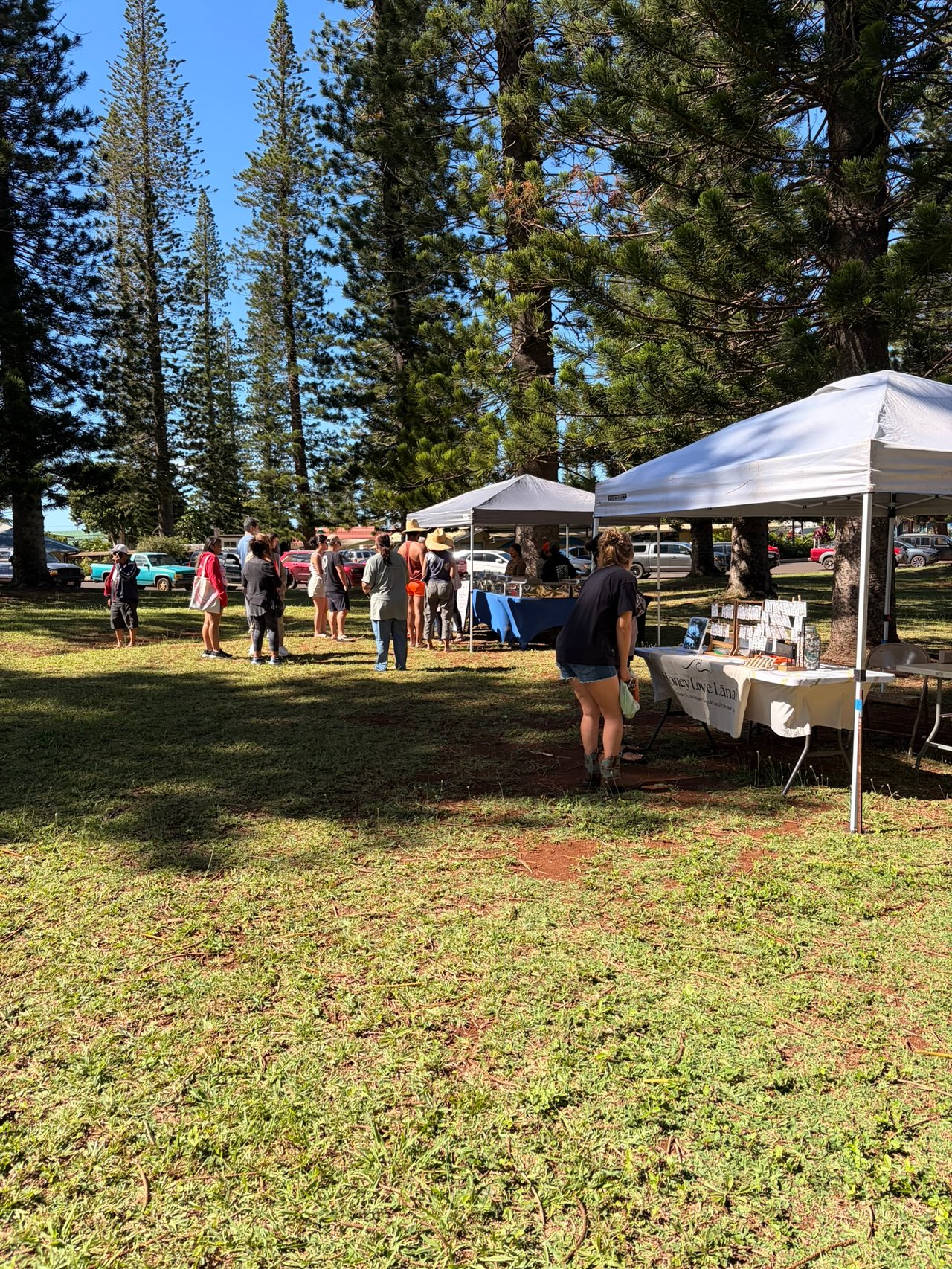
The Dole Park market is the older institution by a long stretch, a Saturday fixture under the Cook pines that's functioned for years as both a food and crafts stand and a social hub, the kind of place where backyard growers sold off surplus eggplant and dragonfruit and everyone stuck around to talk story in the shade. It went dark at the start of the pandemic and stayed dark far longer than anyone on Lānaʻi expected. By early 2023, residents were openly frustrated that the island's only market hadn't come back while farmers markets elsewhere in Hawaiʻi had recovered months earlier.
It took a joint push from the Lanai Community Association and the Lanai Chamber of Commerce to bring it back. A farm stand soft-launched on July 29, 2023, and the fuller Saturday Market, with prepared food and craft vendors added back in, opened on August 12 that same year.
"Members of the community were wanting to see it come back," Kay Okamoto, president of the Lanai Community Association, said at the time. "We hope people will be happy and support all the vendors."
That's still the market running today: produce, prepared food, and retail and craft vendors, generally Second and Fourth Saturdays from around 7:30 a.m. to 11:00 a.m. on the southeast corner of Dole Park. It's the one built by and for the community that already existed, with no county agency standing behind it.
Entry Park's market is a different animal, and the difference is structural, not just geographic. It launched October 4, 2025, as what officials called the first-ever farmers market on Maui County park land, and it exists because of a specific gap the Dole Park market was never built to fill: a formal channel for county agricultural support to reach Lānaʻi.
It's managed by the Hawaiʻi Farmers Union Lānaʻi Chapter, in partnership with the Maui County Department of Agriculture, the County Department of Parks and Recreation, and Councilmember Gabe Johnson's office. It runs only on the first and third Saturday of the month, from 7 a.m. to noon, and it's built around a narrower, more regulated set of goods: local produce, fish, eggs, flowers, and plant seedlings, along with hot food that has to be made with at least 50 percent Lānaʻi-grown ingredients to qualify for a table. Opening day drew vendors including Hale Lānaʻi, Johnson Farms, Kapua Farms, Kumu Ola Farm, the Lānaʻi Culture & Heritage Center, and Lānaʻi Green Resources.
"Markets like this create space for farmers and fishers to connect directly with neighbors, and that keeps more of our food grown, caught and sold here at home," said Kirsten Ham, chief operating officer of the Hawaiʻi Farmers Union.
The county's announcement also tied the market to a longer-term plan: layering in the Maui County-supported Lānaʻi Food Stimulus Program, the federal SNAP program, and the statewide DA BUX program, which doubles the spending power of SNAP shoppers buying local produce. None of that infrastructure exists at Dole Park. It didn't need to. Dole Park's market was never set up as a food-access program, it was a community market that survived a pandemic shutdown through sheer local persistence. Entry Park's market was built from day one as an arm of county agricultural policy, with the paperwork and eligibility rules that come with that role.
One detail from the launch announcement is worth flagging because it's easy to miss and most coverage never revisited it. Hawaiʻi Farmers Union agreed to cover vendor fees for the first six months of the Entry Park market, a pledge made when the market opened in October 2025. Six months from an October 4 launch lands around early April 2026, which means that subsidized window closed several months ago.
That doesn't mean the market changed in any dramatic way. It likely just means the fee structure that vendors face today isn't the one described in last fall's press coverage, which is still what shows up first if you search for the market online. If you're a grower or producer thinking about setting up a table, it's worth confirming current vendor terms directly with the Hawaiʻi Farmers Union Lānaʻi Chapter rather than assuming the free entry from the opening months still applies.
Once you separate what each market is actually for, planning around them gets simple.
The split isn't fragmentation. It's two institutions solving two different problems that used to get squeezed into one market before the pandemic broke that arrangement apart. Dole Park kept the social ritual alive through community persistence alone. Entry Park exists because Lānaʻi needed a market that could plug into county agricultural funding. Knowing which one you're walking into changes what you should expect to find there, and when.
For more on the daily rhythms that shape a week in town, our earlier post on a Dole Park Saturday covers the rest of that weekend loop, and our Lānaʻi City neighborhood page has more on what living in town day to day actually looks like.
Whether you're already settled here or thinking about what life on this island involves before you buy, Okamoto Realty has been paying attention to these details for a long time. Talk with a Lānaʻi real estate expert.
Stay up to date on the latest real estate trends.
We bring together a mix of integrity, imagination and an inexhaustible work ethic, striving to make each buying and selling experience the best possible.